
558h Bet slots and the local practice reels
Learn how the three-symbol practice reels count matches, how the studio catalogue differs, and where to find the exact rules for each featured slot.
Open free demo
Which reels are available here?
Classic slots in the 558h Bet casino is a small, free exercise with three visible positions and five possible symbols. Open the local table, press Spin reels and read the line underneath. Each press creates a new result. A symbol match has no cash value. The exercise gives you a simple way to learn what the symbols and result labels mean before comparing them with the more elaborate designs in the studio catalogue.
The featured studio games form a separate collection. Sweet Bonanza is credited to Pragmatic Play, Starburst to NetEnt and Book of Dead to Play’n GO. Each has its own cover, a short description and a publisher reference. The local practice reels do not reproduce those titles. If you see the words Spin reels above a line with a star, a spade or a seven, you are looking at the local exercise.
Two controls may sit close together on a studio card. The picture and game name lead to the external demo destination through the project link. Game details opens explanatory text under the picture. The publisher reference in that text leads to information about the original game. Choose based on what you want to learn: the origin of a title, the general demo destination, or the behaviour of the small local table.
Five symbols and three positions
The exercise can display a seven, star, diamond, club or spade. Each position is chosen separately. The first symbol does not disappear from the possibilities for the second. That is how a line can show the same symbol three times. The table then compares the symbols by identity. Their colours, positions and decorative appearance on the surrounding artwork do not change the comparison.
Read the symbols from left to right and name each one. The generated text uses exactly those names. This helps when the shapes look small on a phone or when two dark card suits are hard to distinguish. A spade has a pointed top; a club has rounded lobes. Their names in the result line settle any uncertainty without requiring you to enlarge the entire screen.
The number seven is just one symbol in this set. It does not count as seven points and there is no total to add. A line containing a seven, a star and a diamond has three different symbols. Its result is No match. Familiar associations from other games, such as red sevens being particularly valuable, do not create a special rule in this local table.
Three result classes
Three of a kind requires all three positions to contain the same symbol. One pair requires exactly two equal positions. No match means all three are different. These categories cover every possible line, and a single line receives exactly one label. You do not first score a pair and then receive a second result for the third matching symbol. Three equal symbols are classified together.
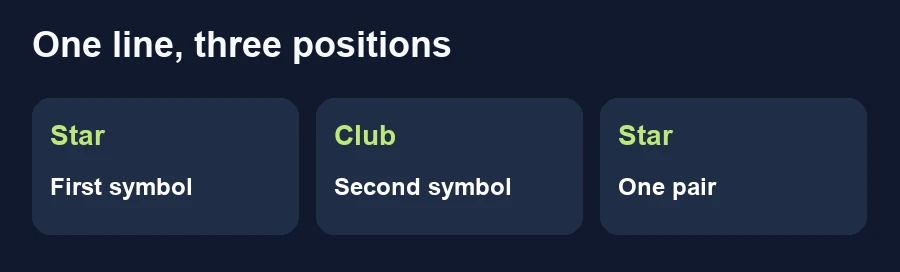
For a quick check, consider star, diamond, star. Only the first and last positions match, so the result is One pair. Change the final star to a club and all three differ, giving No match. Change the middle diamond to a star in the original example and the three stars give Three of a kind. One changed position is enough to move between the categories.
The order matters when describing a specific line, but it does not give one pair priority over another. Diamond, diamond, spade has an adjacent pair at the beginning. Spade, diamond, diamond has one at the end. Diamond, spade, diamond has a separated pair. Every one of these lines is classified as One pair. You need no payline diagram to compare the three positions.
Counting the possible lines
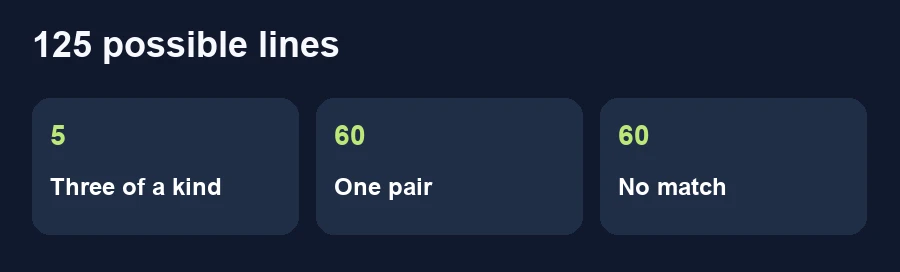
There are five choices for the first position, five for the second and five for the third. Multiplying gives 125 ordered lines. Ordered means that a star followed by two clubs is a different line from two clubs followed by a star, even though both receive the same label. That distinction lets you count the outcomes systematically and check the arithmetic from several directions.
Five of those lines contain three equal symbols. Pick the repeated symbol and the rest of the line is determined. For exactly one pair, choose the paired symbol in five ways, the different symbol in four ways and the position of that different symbol in three ways. That gives sixty lines. For no match, the first symbol has five choices, the second has four different choices and the third has three remaining choices, again giving sixty.
Five plus sixty plus sixty accounts for all 125 lines. Under the exercise's model of fresh, equally likely choices, those counts correspond to four per cent for three of a kind and forty-eight per cent each for one pair and no match. These are properties of the local rule and symbol set. They are not a payout table, and they say nothing about the probabilities used by the original studio titles.
What a short session can show
A visitor could make five spins and see four pairs. Another visitor could play five rounds and see none. A small sample does not have to reproduce the full distribution of possible lines. Forty-eight per cent describes the proportion of ordered lines in the full set, not an instruction for the game to alternate labels or produce a pair by some particular spin.
If you want to compare a real session with the model, draw three columns labelled Three of a kind, One pair and No match. Mark one column after every spin, even for a result that looks uninteresting. Recording only sevens or bright combinations changes the sample you are studying. At the end the three column totals should add to the number of spins you actually made.
Suppose you made ten spins, wrote down five pairs and four lines without a match, and left one line unrecorded. The missing entry is unknown. It could have been any of the categories. You cannot assign it to Three of a kind simply to make the totals look complete. Either keep an unknown column or start a new short record with a clearer procedure. The purpose is understanding results, not chasing a pattern.
A studio title with tumbling symbols
Sweet Bonanza uses a different visual idea from a single three-position line. Its catalogue description focuses on matching symbols disappearing and others taking their place. A visitor who saw one arrangement followed by another might suppose somebody pressed Spin twice. A tumble can instead be a continuation within the same game event. The publisher's own explanation is the right source for the boundaries of a round in the original game.
Take that idea back to the local exercise for comparison. Here one press assigns all three positions and writes one classification. The exercise does not remove a matched pair and fill the resulting spaces. Looking for a second wave of symbols after One pair would therefore be looking for a feature from a different game. A similar fruit or candy theme in the artwork would not change the rules of the local table.
When describing the difference to someone else, name both the screen and the action. “The local row stayed still after a pair” is an accurate report of the expected behaviour. “The tumble stopped working” would assume that the local row had the feature in the first place. Attribution and a clear game name make it much easier to understand a screenshot taken out of context.
Wilds and expanding symbols
Starburst is known for its expanding wild and respin feature. The catalogue names NetEnt so a visitor can follow the reference to the relevant developer. The five local symbols have no wild substitute. A local star is just a star. Star, club, spade contains three different symbols, even if someone associates stars with a wild in another title. The label under the row settles the result.
Book of Dead uses its own setting and special symbols. The explorer shown in material for that title belongs to the original game. A featured cover in this lobby supplies a recognisable reference to the game and its creator, not a promise that the local three-reel exercise reproduces its feature rules. Check the text next to the Play’n GO credit before drawing conclusions from the artwork alone.
One useful question to ask about any symbol is whether it changes the identity of another symbol, changes the space it occupies, triggers a new event or simply counts as itself. Those are different jobs. A screenshot of a large symbol may show its appearance without explaining which job it performs. Read the original game's rule description before transferring any of those meanings to a different screen.
When a spin appears unchanged
Two consecutive local lines can be identical. That may look like a button failed, especially if a visitor glances only at the first position. Read all three symbol names and the complete result label. Also check that you are pressing the table control rather than a saved image of the table. An image can reproduce every visible symbol but has no working button underneath it.
Once a particular line has appeared, the independently selected next line has one matching ordered arrangement among 125 possibilities. The next classification is much less specific. Many different arrangements can produce One pair, so seeing the same classification twice is entirely ordinary. Comparing the words One pair alone therefore tells you very little about whether the actual arrangement changed.
If a control genuinely stops responding, finish reading the current result and reload the table address. Reloading clears the page state. It will not resume a queue of missing spins or calculate rewards for a previous line. If you wish to report a problem, describe whether the symbols changed, whether the text changed, and which browser action preceded the issue. Those observations are more useful than guessing at a hidden outcome.
Choosing where to go next
For another local exercise with one completed event per press, try the single-zero wheel. Its result is a number and colour rather than a relationship between symbols. To make a decision during a round, try blackjack, where you choose whether to take another card. These activities share a browser lobby, but each teaches a different kind of result reading.
If a particular studio theme caught your attention, open its details and read the publisher reference. If you prefer to explore the project demo destination, use the marked play button or cover. For the smallest exercise, use the local table link. Knowing which of those choices you made makes the next screen predictable and keeps pictures, descriptions and playable practice controls easy to tell apart.
For a last check of the counting rule, cover the third position of an example line with your finger. If the first two differ, the last symbol can match the first, match the second, or be one of the three other symbols. If the first two already match, the last symbol can complete a triple or leave the pair intact. Uncover the third position and read the classification. You can run this little exercise on a written example without starting a single additional round.