
558h Bet blackjack hands and ace values
Play through local blackjack examples at 558h Bet. Count soft hands, follow the dealer's draw rule and distinguish an opening blackjack from a later twenty-one.
Open free demo
Take a seat at the local table
The 558h Bet practice table deals from a fresh shuffled deck for each new hand. Use the direct practice link on this page and select Deal hand. Two cards are assigned to you and two to the dealer. The first dealer card is visible while a decision is still yours. This is a local exercise without chips, stakes, side bets, insurance or a payout for winning.
Read the text beginning with You before choosing another action. It lists all your cards and their current total. The large card faces are a visual aid. After several hits they show the latest cards, while the text retains the full hand. If you try to reconstruct the total from the last two large faces alone, you may miss an earlier low card and think the score is wrong.
The control you see also tells you about the stage of the game. Hit and Stand mean the round is still active. Deal hand becomes available again when a result has been reached. If the opening deal already produced blackjack for either side, the round can finish without presenting a decision. Read the final sentence rather than repeatedly pressing the place where you expected Hit to appear.
Count ordinary cards first
Cards from two through ten have their printed value. A jack, queen or king counts as ten. Suits distinguish the cards in the deck but contribute no extra points to the total. A queen of hearts with a seven of clubs therefore gives seventeen. Changing either suit without changing the ranks leaves the scoring arithmetic the same, even though the actual cards are different.
Take a hand of three, five and queen. Add three and five to get eight, then ten for the queen to reach eighteen. A common mistake is to count the queen as twelve because it follows the jack in the sequence of ranks. That sequence matters when naming cards, not when adding blackjack points. All three face ranks share the same value in this exercise.
Counting ordinary cards first helps with longer examples. If you later add an ace to the hand of eighteen, begin with the known eighteen and ask which value for the ace fits. An eleven would produce twenty-nine, while a one gives nineteen. The exercise chooses the latter automatically. There is no separate control that asks whether you would like your ace to be high or low.
Why an ace changes value
The table initially counts each ace as one. If adding ten to that total still keeps the hand at twenty-one or below, it adds ten once. This produces the familiar rule that an ace may count as eleven when it helps without busting. With two or more aces, at most one can count as eleven in a hand that remains at or below twenty-one.
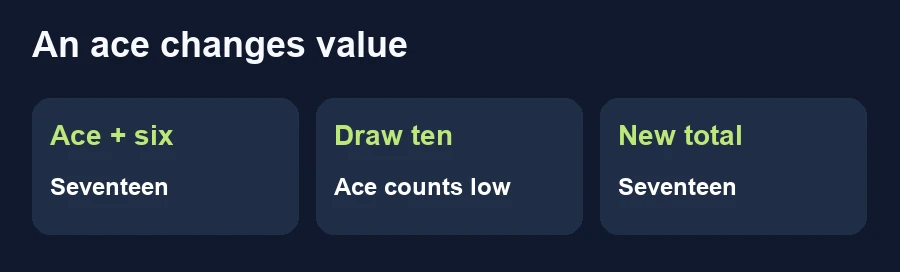
An ace and a six start as seven when the ace is counted low. Adding ten gives seventeen, so the displayed total is seventeen. Now add a ten-value card. Counting the ace low gives seventeen and adding ten would take it to twenty-seven. The displayed total is still seventeen even though a card was added. The ace changed contribution from eleven to one while the new card contributed ten.
With two aces and a nine, start at one plus one plus nine, which is eleven. Adding ten reaches twenty-one. One ace is high and the other is low. Counting both as eleven would produce thirty-one, while keeping both low would miss a valid higher total. The algorithm's single adjustment handles the situation without any special instruction for pairs of aces.
An opening blackjack and a later twenty-one
An opening blackjack is a two-card hand containing an ace and a ten-value card. The table checks both initial hands before giving the player a choice. A player blackjack against a dealer without blackjack produces a completed player win. A dealer blackjack ends the round in the dealer's favour unless the player also has blackjack, in which case the table reports a push.
A three-card total of twenty-one is still a strong finished total but has a different history. Imagine a starting seven and four, followed by a king on Hit. Eleven plus ten equals twenty-one. The table proceeds to the dealer's turn automatically. It does not announce an opening blackjack because you needed a third card to reach the total. The sequence of actions matters to the label.
If the dealer then reaches twenty-one as well, the comparison of equal final totals gives a push. It is possible to see the number twenty-one on your result without the word Blackjack or the words You win. Look at whether the value was reached on the initial deal and what total the dealer finished with. Those two observations distinguish the cases.
What happens when you stand
Stand ends your decisions for the current hand. The dealer draws while the dealer total is below seventeen and stops when it reaches seventeen or more. The same ace calculation applies to the dealer. In particular, an ace and a six give seventeen, so this local dealer stands on that soft seventeen. Other blackjack products can specify different rules, which is why the local threshold is stated explicitly.
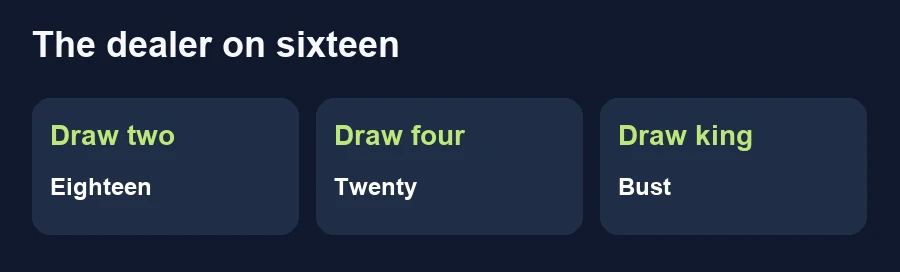
For a worked example, suppose you stand on eighteen and the dealer holds a ten and a six. Sixteen is below the threshold, so the dealer draws. A two would give the dealer eighteen and a push. A four would give twenty and a dealer win. A king would take the dealer to twenty-six and give you a win through the dealer's bust. These are three possible continuations, not a promise about the next drawn card.
Standing on a lower total does not make the dealer copy it. If you stand on twelve and the dealer already has seventeen, the dealer stops and compares the hands. Seventeen beats twelve. If you stand on twenty and the dealer has eighteen, the same stopping rule produces an immediate player win. The dealer acts according to its own total rather than trying to draw until it surpasses yours.
What happens when you hit
Hit takes one card from the remaining deck and adds it to your hand. The table then recalculates the total, including any change to the value of an ace. If you exceed twenty-one, the round ends immediately with a bust. If you reach twenty-one exactly, the dealer completes its turn. If neither condition applies, the updated hand remains open for another decision.
Suppose the opening cards are nine and seven. A five on the next draw reaches twenty-one. A six reaches twenty-two and ends the hand. An ace counts as one and produces seventeen, leaving a decision available. All three examples begin with the same visible sixteen. They illustrate the effect of different next cards; they are not a recommendation to chase a particular outcome in a real game.
A longer example starts with two and three. Add a four to make nine, then an ace to make twenty. If another card worth five is drawn, the ace becomes low and the hand totals fifteen. A displayed total can go down compared with the preceding display even though a new card was added. Recounting the entire hand with every ace low before making the ten-point adjustment explains the change.
Reading the dealer line
During an unfinished hand the line identifies the dealer's visible card and says that one card is hidden. The hidden card already belongs to the dealer. It is not selected to fit your decision after you press Stand. When the hand finishes, the line reveals the dealer's cards and total. Keep the stage of the round in mind if you compare an early screenshot with a final one.
If you bust on a hit, the dealer does not need to draw more cards to beat you. A final line may therefore show a dealer total below seventeen alongside a player loss. That is consistent with the rules. The draw threshold applies when the dealer has to play out a hand after you stand or reach twenty-one. A player bust has already settled the result.
An opening dealer blackjack is another situation where a round ends without the usual choice of standing. The player may hold a perfectly valid number such as nineteen and still lose before taking any action. The result text identifies the dealer blackjack. This is different from a failure of the Hit control: no active player decision remains once the initial blackjack check has settled the hand.
Deck, suits and repeated ranks
The exercise makes a standard set of fifty-two cards using four suits and thirteen ranks, then shuffles that set. Cards already dealt in the current hand have been removed from that deck. You can see two kings of different suits, but you cannot draw the very same king of hearts twice in the same hand. The local deck is rebuilt when you start a new hand.
This differs from the practice reels, where each position makes an independent choice from the same five symbols. Three identical stars can appear in one reel result because the first star is not removed from the next position's choices. On the card table the suit and rank together identify a particular physical-style card. Keeping those two selection models separate avoids several misleading comparisons.
For a hand record, write a rank followed by a suit for each card, in the order shown. Then record whether the final action was Hit, Stand or the opening blackjack check. Someone reading your example can verify the total and the result without knowing your name, phone model or any account information. If you include only a final number, they may have to guess how the ace was being counted.
Returning to an unfinished hand
The hand exists inside the running page. A bookmark can reopen the table, but it does not preserve the shuffle or the hidden card. If the browser reloads the document, a new deal starts a different hand. An identical pair of opening ranks on a later visit is possible by chance. It does not mean that the earlier deck was stored and restored for a particular player.
Finish any decision you want to study before reloading. For a persistent example, write down the full result and compare it with the arithmetic in these sections. When you are ready for a different activity, the single-zero roulette exercise gives a complete result after one press, while the reel exercise compares three symbols. The external demo button is a separate route and does not carry your local blackjack hand with it.
A final example brings the stages together. Give the player an ace, a two and a four. The low sum is seven, so the hand reads seventeen. A hit bringing a nine changes the low sum to sixteen; another ten-point adjustment would be too large. If the player now stands and the dealer finishes on sixteen after revealing two cards, the dealer must draw again. You cannot compare those two sixteens and announce a push yet. First finish the dealer's required action, then compare the totals if both hands are still within twenty-one.