
558h Bet APK identity and modified files
Understand what a 558h Bet APK mod claim means, how publisher identity differs from a familiar logo, and what to check before trusting an Android file.
Open free demo
What a mod claim tells you
A “558h Bet APK mod” label describes a claimed modification. It gives no assurance about who created the file or what was changed. This project has no published Android build against which to compare a supposed modification. No modified package is distributed here. The local practice games run in the browser and require neither an installer nor elevated permissions on the phone.
People often use the same word for very different changes. Someone might describe a new picture on a website as a mod. Another person could mean that an Android package was rebuilt, renamed and signed by a different party. Changing your own browser text size also changes the appearance of the lobby, but it does not alter anyone's package. Before discussing safety, identify exactly what object the claim concerns.
If all you received was an image of a phone displaying a large balance, you received an image. You have not seen a package, a verified publisher or evidence of any account balance. A copied screenshot can be placed next to any link. This is especially important for a free lobby where game results are displayed as text. A result in this lobby cannot establish a right to money on another service.
A name is easy to copy
The characters in a filename are chosen by whoever named the file. Brand spelling, the word official, a country name and a recent year can all be added without the involvement of a publisher. Search engines and messaging apps may display that filename prominently, making it feel like a verified product name. It remains only a label until there is a reliable way to connect it to a publisher.
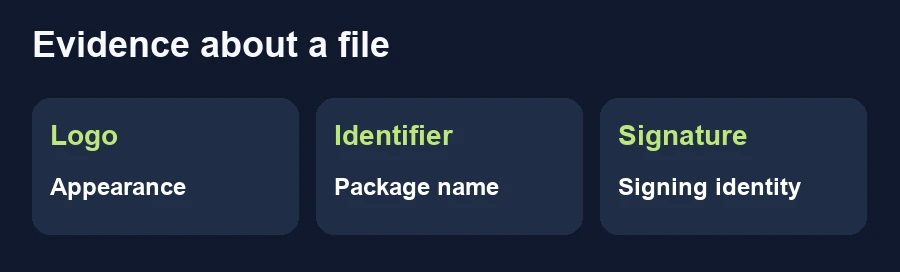
A logo is similarly portable. The current lobby pairs a dark blue background with bright controls and game artwork. Reproducing a recognisable colour combination does not give another page authority to distribute an installer. Even an exact copy of the homepage banner would demonstrate access to an image rather than control of an application's signing identity. Treat graphics as a way to recognise a design, not as the final identity check.
A practical exercise is to imagine replacing the logo with a plain square. What evidence would remain? If the answer is only a shortened link and a promise in a message, the claim is weak. If there is a named publisher, a stable listing, a matching identifier and a documented release history, you have specific facts to investigate. The appearance of the download button is the least important part of that comparison.
The roles of an identifier and a signature
An Android application identifier distinguishes a package at the software level. A signing certificate is used as part of the system that associates applications and updates with signing identities. A familiar display name can coexist with an unexpected identifier or certificate. Each field answers its own question. To connect a file to a real publisher you need a trusted reference from that publisher as well as information about the file.
For example, suppose two pages show the same identifier under the same image. If both copied the information from one unverified message, they are repeating a single claim. They do not become independent evidence through repetition. A publisher-controlled distribution record is more informative. It ties the release details to an organisation or person that can be identified separately from the people forwarding the file.
Signing keys can have documented changes over the life of an application. An unexplained mismatch is a reason to stop and seek an explanation from a trusted source. It is not a reason to remove a known application to make a new file install. For this particular project there is no announced signing reference. We cannot name a certificate fingerprint or certify a package by comparing it with an invented value.
Reading an “unlocked” promise
Think about which system owns the thing that is supposedly unlocked. In the local reel game, Spin reels picks three symbols and the result line describes their relationship. There is no wallet entry to increase. In local roulette, spinning produces a numbered pocket and its colour. In blackjack, the result describes how two hands compare. None of these browser events pays money or changes an account on an external service.
A claim such as “unlimited free spins” can exploit the ambiguity between free practice and an offer with monetary terms. You can already start another practice spin using the local button. That does not create promotional spins on a different site. If a message asks for a package installation to convert a local result into credit, ask where the entitlement is recorded and which verified operator grants it. No such mechanism exists in this lobby.
The welcome graphic also needs context. Its figures illustrate a proposed offer and the nearby details state the preview status. A picture showing the same figures inside an alleged modified application proves nothing about eligibility. A real entitlement would require defined terms and a system capable of recording it. Reusing the wording of the preview does not create that system, even if the screen looks polished.
What permissions have to do with a game
A permission request should have an understandable connection to the task you chose. Reading an article or comparing two blackjack hands on this site does not require access to your contacts, camera or microphone. The browser site provides its own controls. If a separate file requests broader access, that request belongs to the file you are considering. It is not a requirement imposed by the local game rules.
Consider a visitor who wants the result of a roulette spin. The result consists of a number and a colour shown in the page. There is no need to photograph an identity document to obtain that result. A different service may have different rules, but a claim about verification on a different service does not create a requirement to upload a document to a random download page.
If an unexpected permission prompt appears, pause before accepting it and identify the app or browser tab asking. Read the name in the device interface rather than relying on artwork underneath the prompt. You can decline a request and leave that location. If you are uncertain what you previously granted, review permissions in the phone's settings for that application. You do not need to grant new permissions just to inspect existing choices.
A file saved in Downloads
A downloaded file is not automatically proof that an application was installed. Find the file using the normal file manager if you need to identify or remove it. Check the list of installed apps separately if you believe you completed an installation. These two checks tell you different things. Repeatedly tapping the file to see what it does introduces an unnecessary step when your aim is only to remove it.
If you can recall the original message, record the displayed destination or the name of its sender before deleting the conversation. A record can be useful if someone else in a group received the same claim. Keep it factual. Say that the project has no published Android release and that the sender's file could not be verified. Describing an unexamined file as a proven piece of malware would go beyond the evidence.
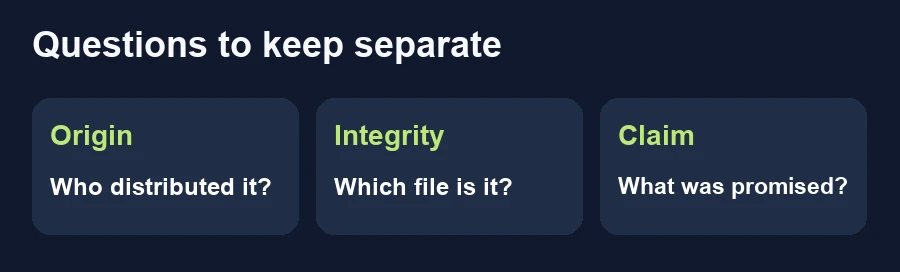
Google Play Protect can warn about potentially harmful applications. Keep that protection enabled and pay attention to the warning itself. A result that reports no detected issue has a narrower meaning than publisher verification. It does not tell you that a brand authorised the distributor, that every claim in a message is true, or that an illustrated bonus exists. Those questions require different evidence.
If you have already entered information
Identify what was shared and where. Entering an email address into a web form is different from entering a password, and both are different from granting an installed app access to contacts. A useful response starts with that distinction. This lobby has no local account form. A form that requested credentials after you left the domain belongs to another destination and cannot be reset through this website.
If a password was entered on an unfamiliar page and reused elsewhere, visit the genuine service independently to change it. Use a saved trusted address or open its established application. Do not follow a second “recovery” message from the same unverified source. Keep one-time codes private. The account owner or service that actually issued the credential is the right place to manage that credential.
If the concern is a transaction rather than a password, preserve the genuine transaction record and contact the payment provider through its own established channel. A practice round on the local wheel has no payment receipt. A screenshot of a winning hand cannot reverse a payment. Keeping the financial record separate from the game illustration helps the provider understand what actually happened without receiving irrelevant details about play.
Comparing a publisher page with an advertisement
An advertisement can tell you that somebody wants attention for a file. A publisher page should help identify the release even after the advertisement disappears. Look for a stable product identity, an explanation of the distribution channel and consistent information about versions. A button that simply leads to another button does not supply those facts, no matter how many screens call the file “official”.
The studio links under featured games serve a different purpose. They identify the creators of the original slot titles shown in the catalogue. A link to the publisher of Starburst helps you learn about Starburst. It does not identify the author of a supposed 558h Android package. Attribution for artwork and proof of software distribution should not be borrowed from one another.
Before forwarding a file to another person, ask whether you can explain where its publisher documents that exact release. If you cannot, share the browser address instead when the goal is to show the free lobby. The recipient can open a practice table without installing anything. If they only wanted to see a particular game illustration, direct them to the catalogue and its publisher details.
A useful result when the evidence is incomplete
There is no obligation to reach a yes or no verdict about every file encountered online. “The claimed publisher is unverified” is a complete and useful finding. It explains why the file should not be treated as an official release without asserting knowledge of its internal behaviour. Keep that distinction if a friend asks you to identify a file using nothing more than its icon.
For this project the known facts are straightforward. The published experience is a website; the three local practice games have no cash stakes; an Android package and a modified edition are not offered here. A future verified release would need its own publisher and release record. Until those facts change, playing a round or reading about a game is a browser task, and neither activity depends on trusting an unknown installer.
If someone later provides a publisher record, revisit just the claims that record actually supports. Confirmation of an application name is one piece of evidence. Confirmation that a particular downloaded file is the publisher's artifact requires a connection to that specific file. Leave unrelated promises, payment claims and promotional screenshots out of that comparison.